
Criminal Court Records in Jackson County
A Jackson County criminal court record is the case file kept by the court clerk once charges are filed. It is a running account of the case. Each hearing, motion, plea, and order is logged in order. The clerk who serves the trial court has care and custody of that file. For felony matters, the Jackson County Clerk acts as Clerk of the 4th Circuit Court and keeps those files. District Court and Probate Court keep their own court-level records. The file grows as the case moves, so an active case and a closed case can look very different.
Court staff maintain these records under state court rules, not under ordinary open-records law. A public criminal court file can include the charging document, the register of actions, motions, orders, the plea, trial events, the judgment of sentence, and any probation order. Michigan protects certain identifiers inside those filings. The county's judicial branch offices sit together at the courthouse downtown. A quick look at the county's Courts, Judicial, and Jury services page shows how the trial courts, the clerk, and support offices connect.
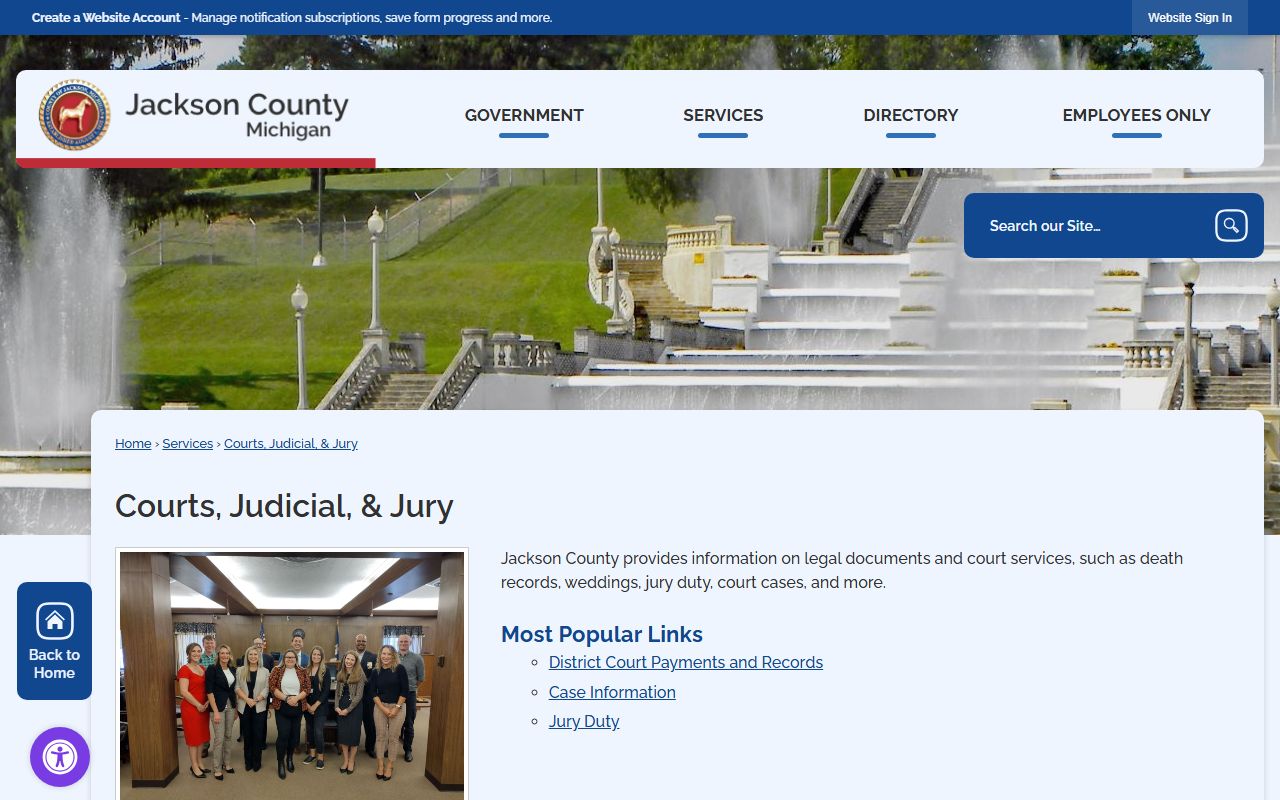
That structure matters because a single criminal case can touch more than one court level. A felony often begins in one court and ends in another. Reading the file well means knowing which court held which stage.
Where Jackson County Criminal Cases Begin
Every adult criminal case in Jackson County starts in the 12th Judicial District Court. That is true for a small misdemeanor and a serious felony alike. The District Court holds the first hearing, sets bond, and opens the file. What happens next depends on how serious the charge is.
Misdemeanors punishable by not more than one year stay in District Court. That court handles the plea, any trial, and the sentence. Felonies follow a longer path. The District Court holds the arraignment, a probable-cause conference, and a preliminary examination. If the judge finds probable cause, the felony is bound over to the 4th Circuit Court. The Circuit Court then takes the plea or trial and imposes any sentence. The county's District Court criminal page lays out this early process.
Federal criminal cases are a separate track. They are not held by the Jackson County Clerk. Jackson County sits in the U.S. District Court for the Eastern District of Michigan, and those files are searched through the federal system. The lead-in below points to the U.S. District Court for the Eastern District of Michigan.
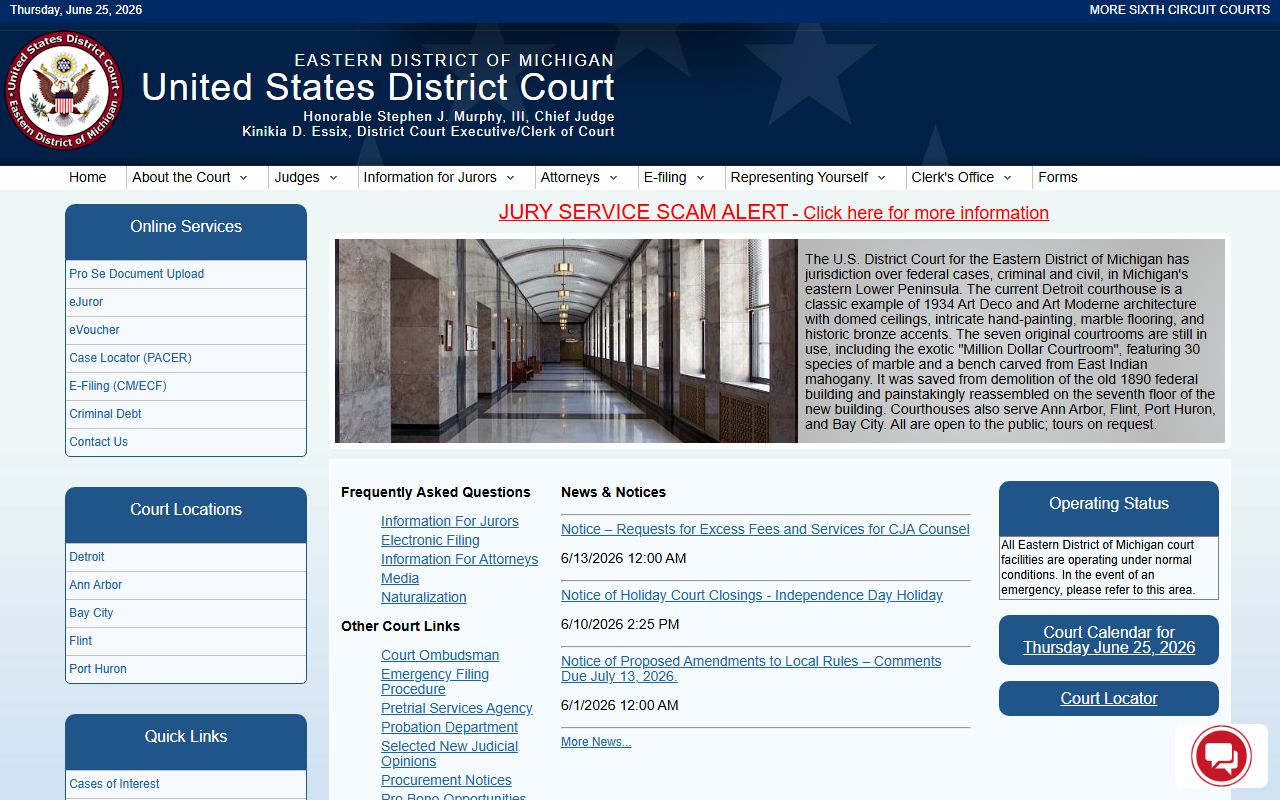
Federal dockets use PACER, not MiCOURT. Keep that split in mind when a search turns up nothing local. A federal charge will never appear in the county court index.
How to Search Jackson County Criminal Court Records
Jackson County routes online case lookups to MiCOURT, the statewide court search tool. It covers District and Circuit criminal matters where the court makes them public. A public search can show case-level details. It will not hand over document images, because Michigan court rule MCR 8.119(H) bars internet access to court document images.
- Open the MiCOURT Case Search portal and choose the name or case-number tab.
- Enter the defendant's last name, or type the full case number.
- Narrow the results by court, case type, and filing date.
- Open the case to read the register of actions and the disposition.
- Request a certified copy from the clerk when you need the actual document.
One quirk is worth noting. Some courts display a criminal conviction only when sentencing fell within seven years of the search date. A secured background search, open to authorized users approved by the state court office, can search by date of birth. A casual public search cannot.
Stages of a Criminal Case
A criminal case moves in steps. Each step leaves its own mark in the record. Reading a file is easier when you can name the stage you are looking at.
Case flow: Charges Filed › Arraignment › Probable-Cause / Preliminary Exam › Plea or Trial › Disposition › Sentencing
| Stage | What Happens |
|---|---|
| Arraignment | The court reads the charges, advises the defendant of rights, sets bond, and may appoint counsel. |
| Probable-Cause / Preliminary Exam | For a felony, the District Court decides whether enough proof exists to send the case to Circuit Court. |
| Plea or Trial | The defendant pleads, or the case goes to trial before a judge or jury. |
| Disposition | The outcome is entered: guilty, not guilty, dismissed, or other result. |
| Sentencing | The court imposes any jail term, probation, fines, costs, or restitution. |
Note: A felony file can show two courts because the same case is arraigned in District Court and later sentenced in Circuit Court after bind-over.
What a Jackson County Criminal Court Record Shows
A criminal court file is built from many small fields. Together they tell the story of the case. The list below reflects the fields a searcher may meet in Jackson County court files and the MiCOURT result screen.
| Field | What It Shows |
|---|---|
| Case Number | The unique ID the clerk assigns to the case. |
| Court Location | Whether the matter sits in District or Circuit Court. |
| Defendant / Party Name | The person charged, plus party type and any alternate names. |
| Charges | Each count, its statute, and its severity level. |
| Judge of Record | The judge assigned to the case. |
| Register of Actions | The dated list of every hearing, motion, and order. |
| Plea | Guilty, not guilty, no contest, or stand mute. |
| Disposition | The final result of each charge. |
| Sentence | Jail, probation, fines, costs, or restitution ordered. |
Michigan rule MCR 1.109 keeps certain identifiers out of public filings. Date of birth, Social Security number, driver license number, passport number, and financial account numbers should not appear in a public criminal filing. The broader set of Jackson County court records follows the same protected-information rule.
Charges vs. Convictions
Being charged is not the same as being convicted. A criminal court record can list charges that were dropped, dismissed, or ended in acquittal. A charge is only an accusation. A conviction is a proven result. Reading the disposition beside each charge keeps the two apart.
| Charge | Conviction | |
|---|---|---|
| Stage | Accusation filed by the prosecutor | Verdict or accepted plea |
| Burden of Proof | Probable cause | Beyond a reasonable doubt |
| What It Proves | Only that a case was brought | That guilt was established |
| Public Record | Yes | Yes |
A file with three charges may end with one conviction and two dismissals. The charge-by-charge look at each count is covered on the Jackson County arrest records and court charges page.
Reading Dispositions and Sentences
The disposition is the outcome. Common entries include guilty, not guilty, dismissed, and no contest. A no-contest plea accepts the penalty without admitting the facts. Some cases end in a deferred or diversion result, where a plea is held back if the defendant meets conditions. The judgment of sentence records what the court ordered.
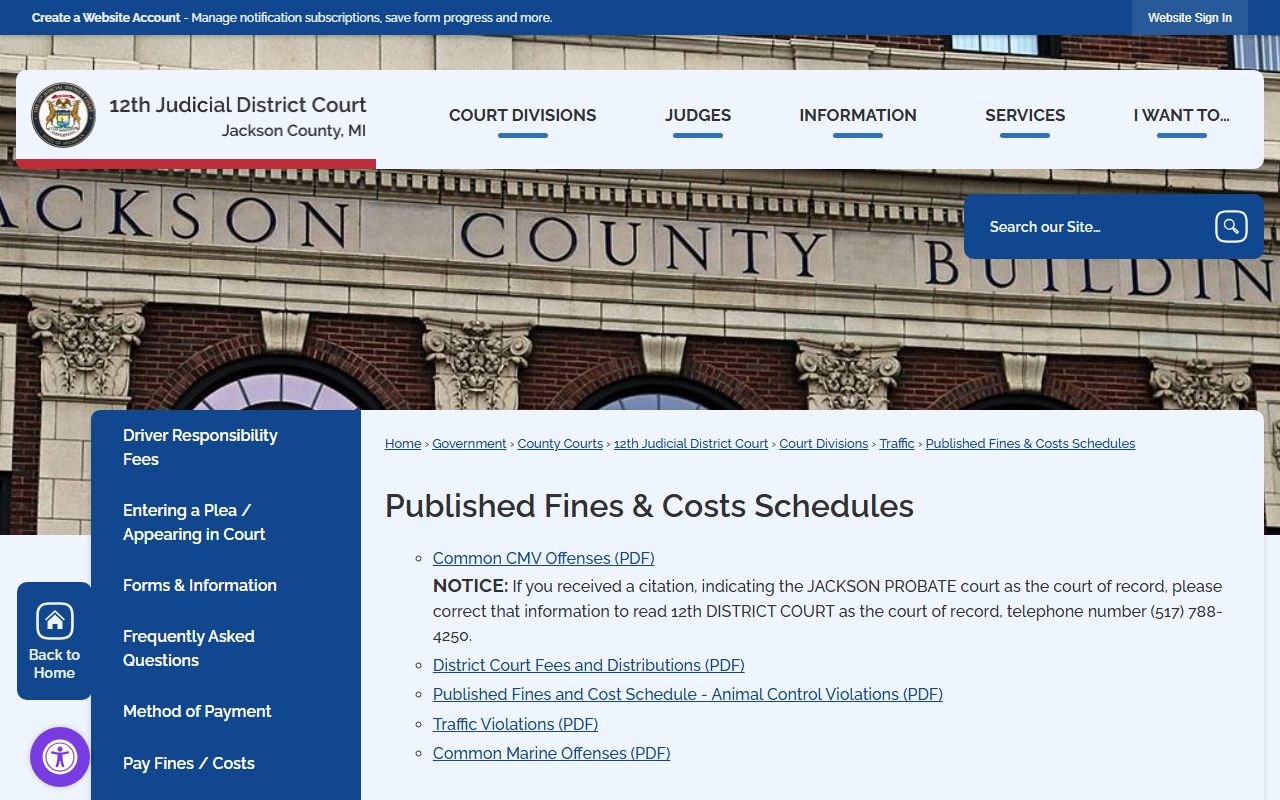
A sentence can mix several parts. It may set jail time, probation, fines, court costs, and restitution to a victim. Fines and costs in District Court follow published schedules. The county's published fines and costs schedules show how those amounts are set.
Probation adds its own line items. An order of probation lists the rules the person must follow, and a discharge from probation closes that chapter. Both appear as separate documents you can request from the court.
Requesting Criminal Case Copies
MiCOURT shows the case. The clerk provides the paper. Two request forms cover most needs, and the right one depends on the court that held the case.
- The District Court criminal and traffic record request form covers the complete case file except nonpublic records, plus the judgment of sentence, order of probation, and discharge from probation.
- The Circuit Court clerk record request form covers felony Circuit Court documents, the register of actions, the complaint, and the judgment of sentence.
- Regular copies cost one dollar per page. A certified copy costs ten dollars for the first page and one dollar for each added page.
- Files more than ten years older than the current year may sit on microfilm, so older records can take longer to pull.
Two offices shape every criminal case. The Jackson County Prosecuting Attorney, Kelsey Guernsey, brings the charges and conducts the trials. The Jackson County Public Defender represents people who cannot afford a private lawyer and staffs every arraignment in the 12th District Court. Their filings and appearances show up throughout the record.
Public Access to Criminal Court Records
Michigan treats court records differently from other public records. Case records are public unless a statute, court rule, case law, or court order restricts them. At the same time, the courts are not covered by the state Freedom of Information Act. That means a criminal court file is requested through the court, not through a FOIA letter to a government office.
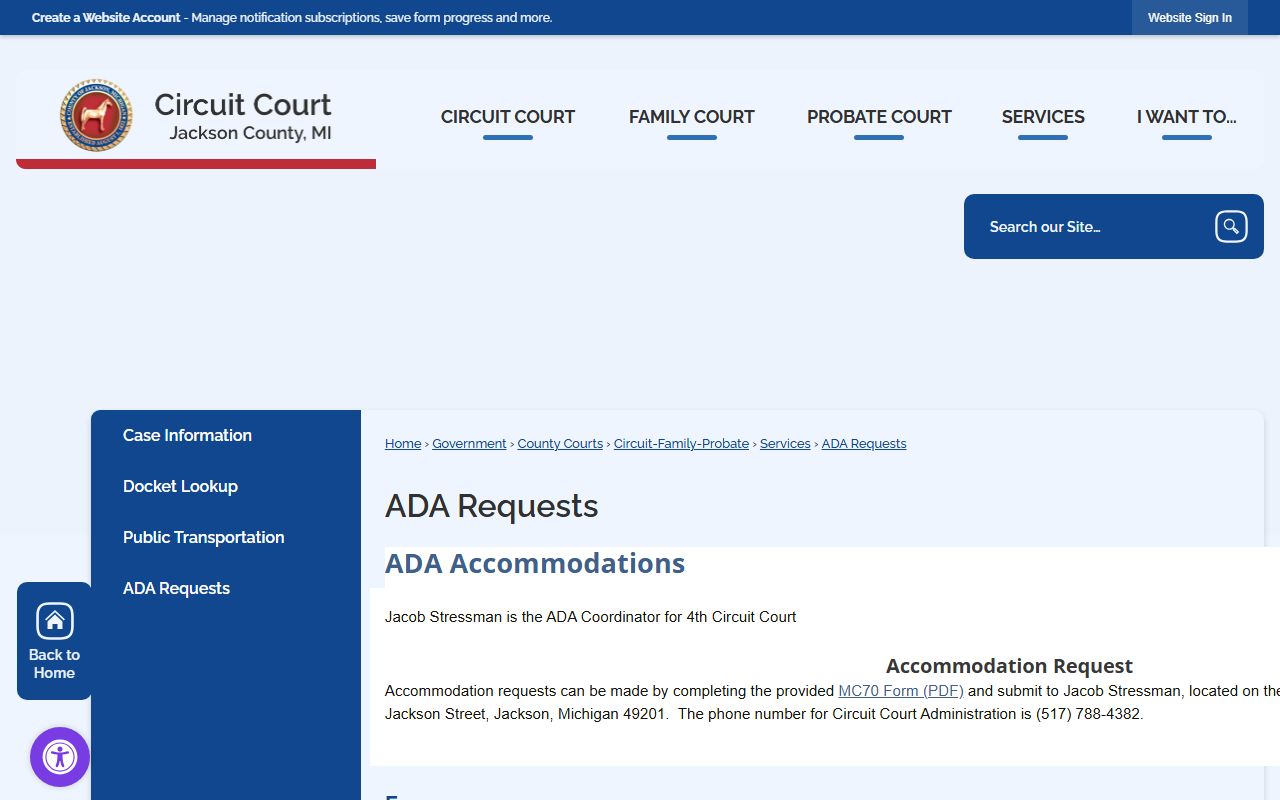
Reasonable accommodation is part of court access. The 4th Circuit Court publishes an ADA accommodation request page for people who need help using the court.
Key Statutes:
MCL 15.232 - Michigan's FOIA excludes the judiciary, so court files are requested under court rules.
MCL 600.1428 - Authorizes the state court office to set records-management and access policy for the trial courts.
Set-Aside and Clean Slate Records
Michigan uses the term set aside for what many call expungement. An eligible conviction can be set aside, which changes public access to that record. The state's Clean Slate reforms widened the list of eligible felonies and misdemeanors and added some automatic processes. Not every record can be cleared. Eligibility turns on the conviction type, the waiting period, the total record, and statutory limits.
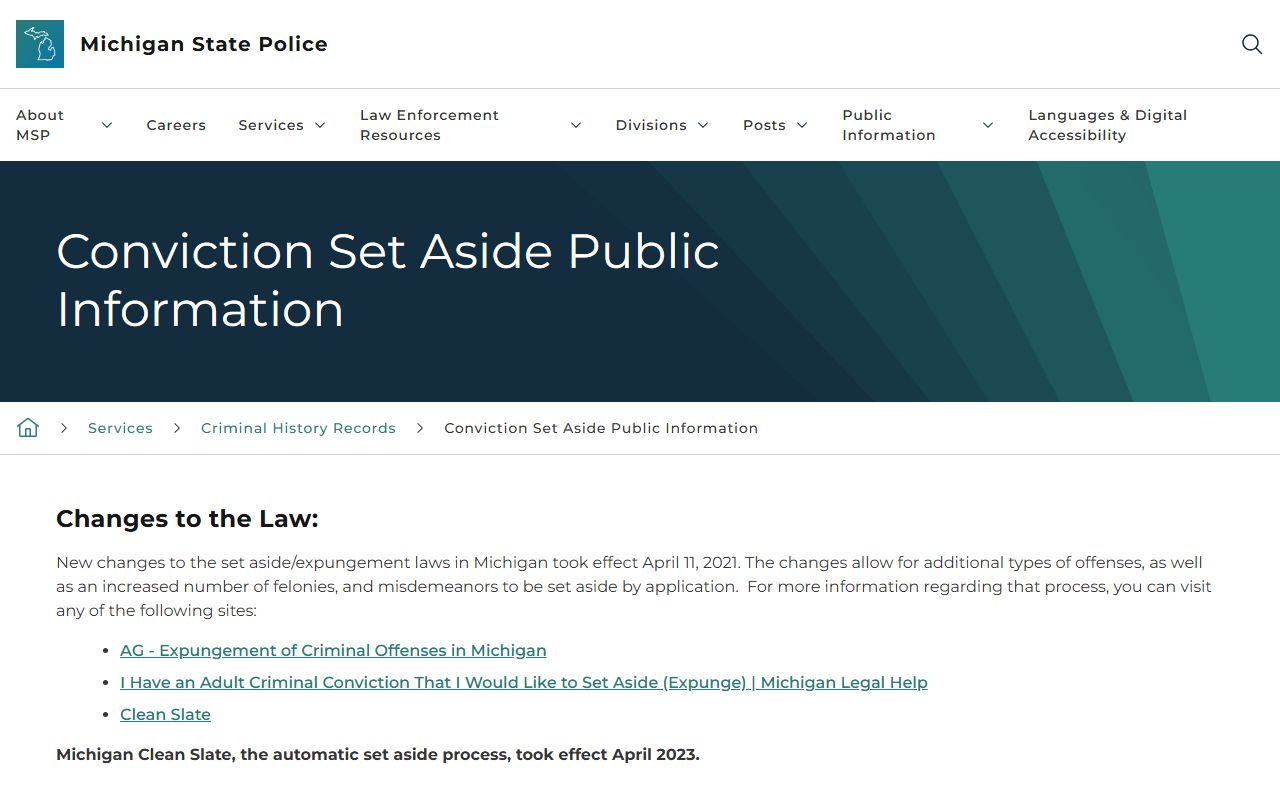
The application uses the state form and is filed in the court where the conviction occurred. A separate application is needed for each court. The Michigan State Police publishes clear public guidance on how a set-aside changes what shows up. The lead-in points to that conviction set-aside public information page.
| Sealed | Expunged (Set Aside) | |
|---|---|---|
| Visibility | Hidden from public view | Treated as though the conviction never happened for most purposes |
| Law Enforcement | Limited access remains | Courts and police may keep access where law allows |
| How It Starts | By rule, statute, or court order | By application on form MC 227, or by Clean Slate automatic process |
The MC 227 application is the standard way to ask a court to set aside a conviction. Special forms apply to some marihuana and human-trafficking-related convictions.
Restricted Criminal Court Records in Jackson County
Some criminal-related files are closed to the public. Juvenile records are the clearest example. Under MCL 712A.28, Juvenile Code records are open only as the law or a court order allows. Juvenile delinquency and juvenile traffic files are nonpublic from the moment they are created.
Other records fall out of online view even when the court holds a file. Mental illness matters, personal protection orders, and name-change petitions are not displayed online in Jackson County. A sealed record is kept so that it is not open to public inspection. When someone asks about a nonpublic file, the court may respond that there is no public record. That answer does not always mean no file exists. It means the file is not open to public view.
Note: A dismissed or set-aside charge can drop off public search results even though the underlying court file still exists in restricted form.