
Jackson County Arrest Records and Court Charges
An arrest record marks the point where law enforcement takes a person into custody. In Jackson County, that step runs through the Sheriff's Office and the local police agencies. The record of the arrest itself sits on the booking side. It notes who made the arrest and when the person was booked. The Jackson County Sheriff's Office leads that side of the process.
Court charges after arrest are a different record. An arrest does not decide the charges. The prosecutor reviews the case and decides which charges to file with the court clerk. Those filed charges become the court charge record, and the court tracks them from there. Booking detail and current custody sit with the jail, so the Jackson County jail roster and booking information is the place to check who is in custody. The charges themselves live in the court file.
Arrest Records vs. the Court Charge Record
The arrest and the charge are two links in one chain. Keeping them apart avoids a lot of confusion. An arrest record answers who was taken in and when. A court charge record answers what the prosecutor filed and how the case is moving.
Jackson County does not publish a single county-only online jail roster. For custody status and release or transfer alerts, Michigan VINE is the tool many families use. The lead-in points to Michigan VINE, the state custody and case notification service.

VINE tracks custody. It does not show the formal charges the way a court file does. For the full case file, the pleas, and the outcome, the Jackson County criminal court records page follows the case from the first hearing to the sentence.
How Charges Get Filed After an Arrest
The charge record begins when the prosecutor files a charging document. That paper names each charge and starts the court case. Michigan uses three main charging documents. The one used depends on how the case is brought.
| Complaint | Information | Indictment | |
|---|---|---|---|
| Filed By | Prosecutor, sworn before the court | Prosecutor after bind-over | Grand jury |
| Common For | Misdemeanors and the start of felonies | Felonies moving to Circuit Court | Rare, serious felonies |
| Role | Opens the case and states the charge | Replaces the complaint after preliminary exam | Charges by citizen grand jury finding |
Most Jackson County felonies begin with a complaint and warrant, then move to an information once the case is bound over. A grand jury indictment is far less common in Michigan practice. Each document lists the counts, and the file may carry several charges from one arrest.
Who Files and Defends the Charges
Charges in Jackson County are filed by the Prosecuting Attorney, not a district attorney. Kelsey Guernsey serves as the county Prosecuting Attorney. The office reviews misdemeanor and felony warrant requests and decides what to charge. It also serves as the county's chief law enforcement office, reviews search warrants, and conducts the criminal trials. The Prosecuting Attorney divisions page shows how the Circuit Court team, the District Court team, and the appellate team split that work. The District Court team also handles felony preliminary hearings and misdemeanor prosecutions.
On the other side stands the defense. The Jackson County Public Defender represents people who cannot afford a private lawyer and face charges that could bring jail. The office opened in 2019 and works under state indigent-defense standards. The lead-in below points to the Jackson County Public Defender office.
Both offices leave a trail in the charge record. Warrant requests, charge decisions, appearances, and motions all show up in the case file as it grows.
District Court Arraignment and Bond
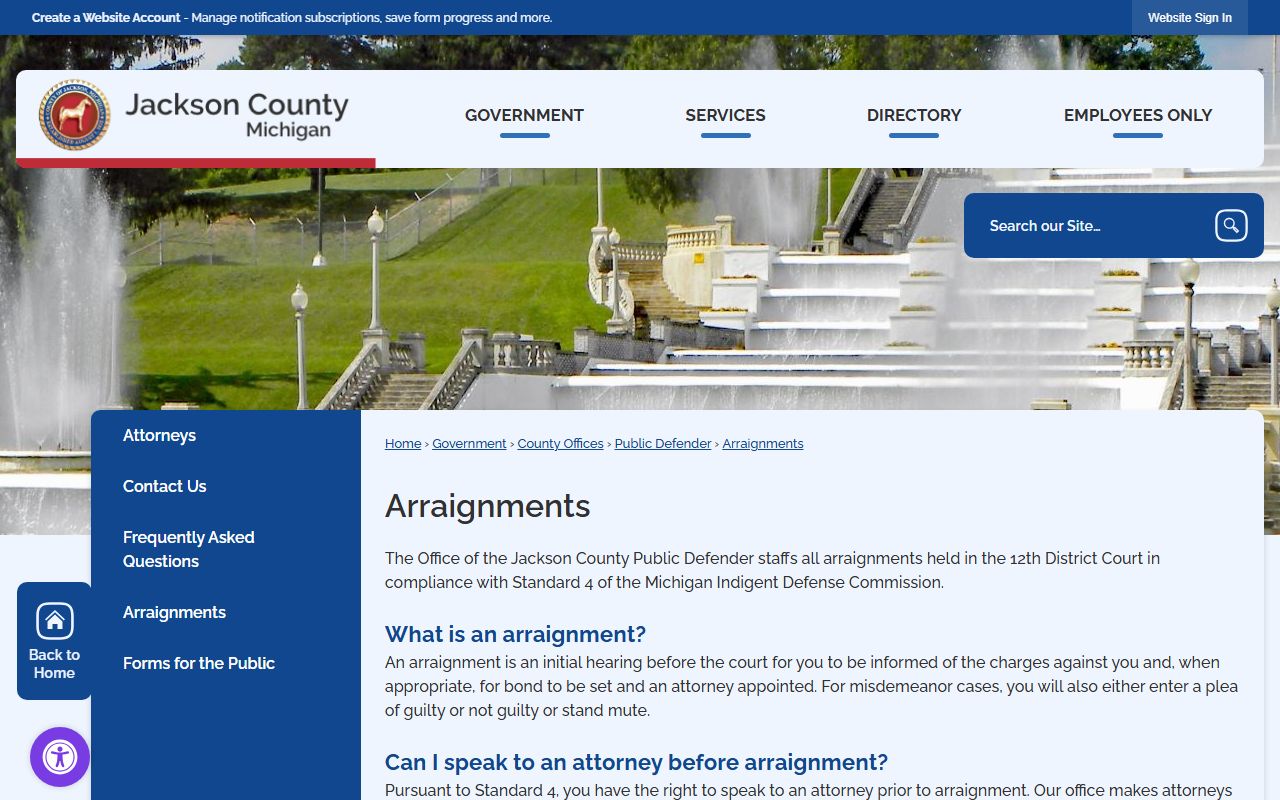
Every adult case begins in the 12th Judicial District Court. The first hearing is the arraignment. There the court reads the charges, advises the person of their rights, and sets bond where the law allows. A misdemeanor defendant may plead guilty, plead not guilty, or stand mute. The Public Defender staffs every arraignment in the District Court. The lead-in points to the county's arraignment information page.
Bond conditions set the terms of release while the case is open. The arraignment is also where counsel may be appointed. From there, a misdemeanor stays in District Court through plea, trial, and sentence. A felony moves toward its next stage.
Note: The arraignment is a court event, so it appears in the court charge record even when the arrest itself is logged on the booking side.
Felony Preliminary Examination
Felonies get an extra step before they reach the 4th Circuit Court. After arraignment, the District Court holds a probable-cause conference and a preliminary examination. At the exam, the judge decides whether enough proof exists to send the case forward. This is a screening stage, not a trial.
If the judge finds probable cause, the felony is bound over to Circuit Court. The prosecutor then files an information, and the case takes its plea or trial in the higher court. The District Court divisions page describes where preliminary exams and felony first stages sit. Charges can change at any point along this path.
Charge Status and What It Means
Charges are not fixed. They shift as a case moves. A count can be amended, reduced, added, dropped, or dismissed. Reading the status beside each charge shows where things stand. The common terms are simple once you know them.
| Status | What It Means |
|---|---|
| Pending | The charge is open and the case is still active. |
| Amended / Reduced | The charge was changed, often to a lesser offense. |
| Dismissed | The court ended the charge without a conviction. |
| Nolle Prosequi | The prosecutor chose not to pursue the charge. |
A single arrest can produce several charges that end in different ways. One count may bring a conviction while another is dismissed. The status column is where that split shows up.
Charge Codes and Severity Levels
Each charge is tied to a statute. That link is the charge code. It names the exact law the count is built on. Michigan sorts offenses by severity, and the level shapes which court hears the case and what penalty is possible.
Misdemeanors are lower-level offenses, many punishable by not more than one year in jail. Felonies are more serious and carry longer penalties. Civil infractions, such as most traffic tickets, are not crimes at all. One arrest can carry a mix of levels. A person might face a felony count and a misdemeanor count in the same file, each with its own code and its own path.
Charges vs. Convictions
A charge is an accusation. A conviction is a proven result. The difference matters because a charge record can hold counts that never led to a conviction. Dismissed and reduced charges stay in the file. Reading the disposition keeps the two apart.
| Charge | Conviction | |
|---|---|---|
| Stage | Filed by the prosecutor | Verdict or accepted plea |
| Burden of Proof | Probable cause | Beyond a reasonable doubt |
| What It Proves | Only that a case was brought | That guilt was established |
| Public Record | Yes | Yes |
Note: A person shown with charges after arrest is not proven guilty of anything, and the file may end in dismissal or acquittal.
How to Find Jackson County Arrest Records and Charges
Charges show up in the court case index. Jackson County routes online lookups to MiCOURT, the statewide case search. Arrest and booking detail sit with the Sheriff, and current custody runs through the jail phone lines and VINE. The court file is where the charges themselves are tracked.
- Open MiCOURT Case Search and choose the name or case-number tab.
- Search by the defendant's name, or type the full case number.
- Open the case and read the charge list, or case entitlement.
- Check each charge's code, level, and current status.
For a police report or a booking record that is not in the court file, the Sheriff's Records Division uses a public-records request. The Sheriff technology page outlines the tools the office uses to log and share this information.
In a public search, a charge may appear as the case entitlement, along with a police incident number, party actions, and court events. Those fields give a picture of the case without the paperwork behind it. MiCOURT may show a charge and its status but not the actual charging document. For a copy of the complaint or information, the court clerk handles the request. A police report or booking record held by law enforcement is requested from the Sheriff, since those records are not part of the court file.
Sheriff Mobile App and Arrest Information
The Sheriff's Office offers a mobile app that shares public safety information and lets residents submit tips. It is a way to reach the office, not a court charge database. Features shift as the app updates, so the app is best treated as a companion tool. The lead-in points to the Jackson County Sheriff's Office app listing.
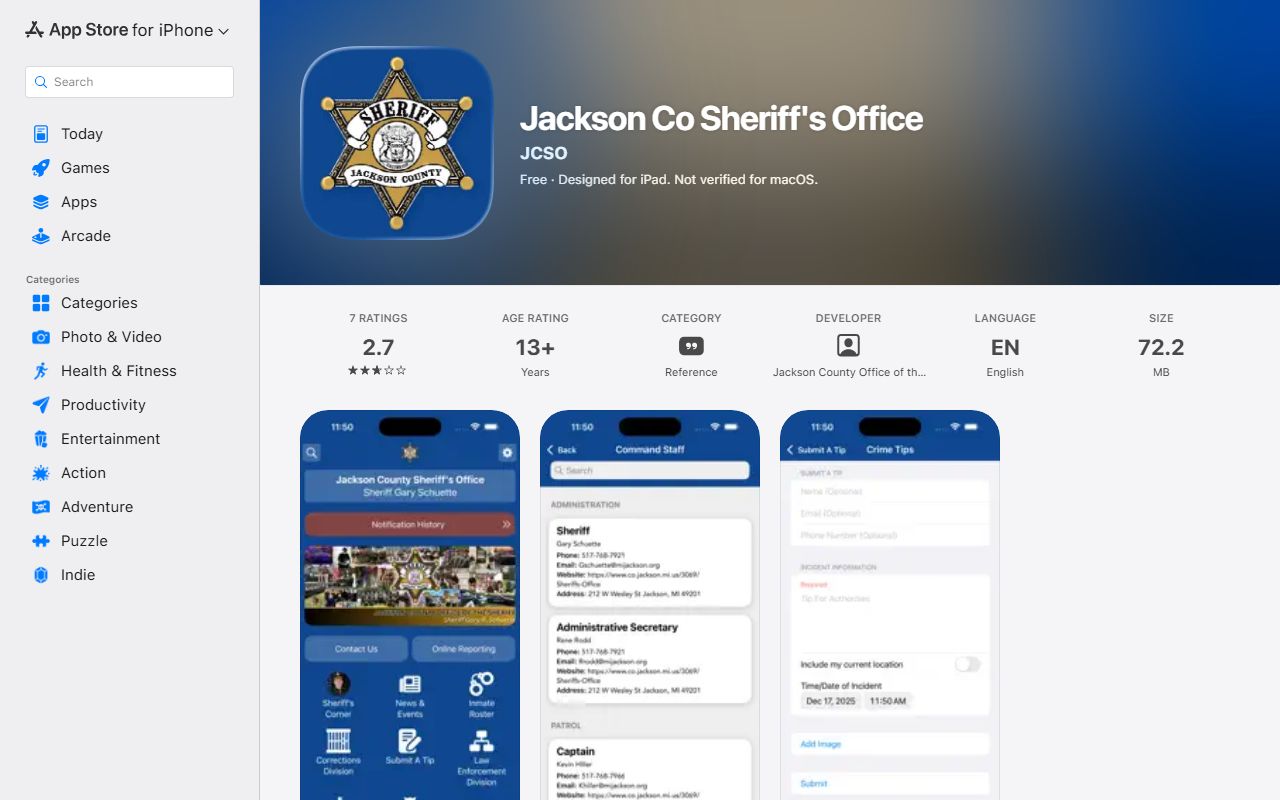
The app and older county technology references cover crime tips, wanted persons, and public safety alerts. For the formal charge record, the court file remains the source. The app cannot confirm a charge status the way the court index can.
Statewide Criminal History Lookups
Charges that end in conviction can roll up into a statewide criminal history. Michigan State Police runs ICHAT, the internet criminal history access tool, for public conviction searches across the state. A local check at the Sheriff covers only bookings at the Jackson County Office of the Sheriff, so a statewide search is broader.
A statewide history shows convictions, not every arrest or dropped charge. It is a snapshot of the record as reported to the state. For the county case detail, MiCOURT and the court clerk stay the better source. The two views work together rather than replacing each other.
Restricted Charge Records in Jackson County
Not every charge is open to the public. Juvenile charges are the clearest limit. Under MCL 712A.28, Juvenile Code records are open only as the law or a court order allows. Juvenile delinquency and juvenile traffic charges are nonpublic from the start.
Other charges drop out of public view. Some courts show a conviction only when sentencing fell within seven years of the search. Sealed and set-aside charges leave public search results even when the court still holds a file. When a charge is nonpublic, the court may answer that there is no public record. For the full case file, the pleas, and the outcome behind any charge, the criminal court records page carries the complete account.